essay · PFAS compliance
Where the PFAS spreadsheet breaks
If you make a product sold in Minnesota, or put your brand on one, and it contains intentionally added PFAS, you have to report it to the state. Most mid-sized manufacturers start where they keep everything else: a spreadsheet. A row per part, a column per supplier answer, a tab for the filing.
For the first pass, that works. The trouble comes later, at seven moments the spreadsheet wasn't built for. Here they are, and what Verarbo does at each. Many first reports were filed on the best data available; the yearly update is where they get better.
first
"Isn't it in the ERP?"
Part of it is. The ERP knows every part, every supplier and every bill of materials. But ask which parts contain PFAS, and how you know, and the answer is in four places:
- the parts and suppliers, in the ERP;
- the supplier declarations, in someone's inbox;
- the substance data, in a spreadsheet one person keeps;
- the PRISM file, in a folder, or not started yet.
Verarbo brings the four together. It takes your parts and suppliers from your ERP's export or straight from its database, keeps every supplier's answer with its source, and fills the PRISM file. Your ERP stays as it is: see Verarbo beside an ERP.
video · narrated, with captions
Watch the seven moments
Prefer to read? The same seven moments, below.
01 / 07
"Where did this number come from?"
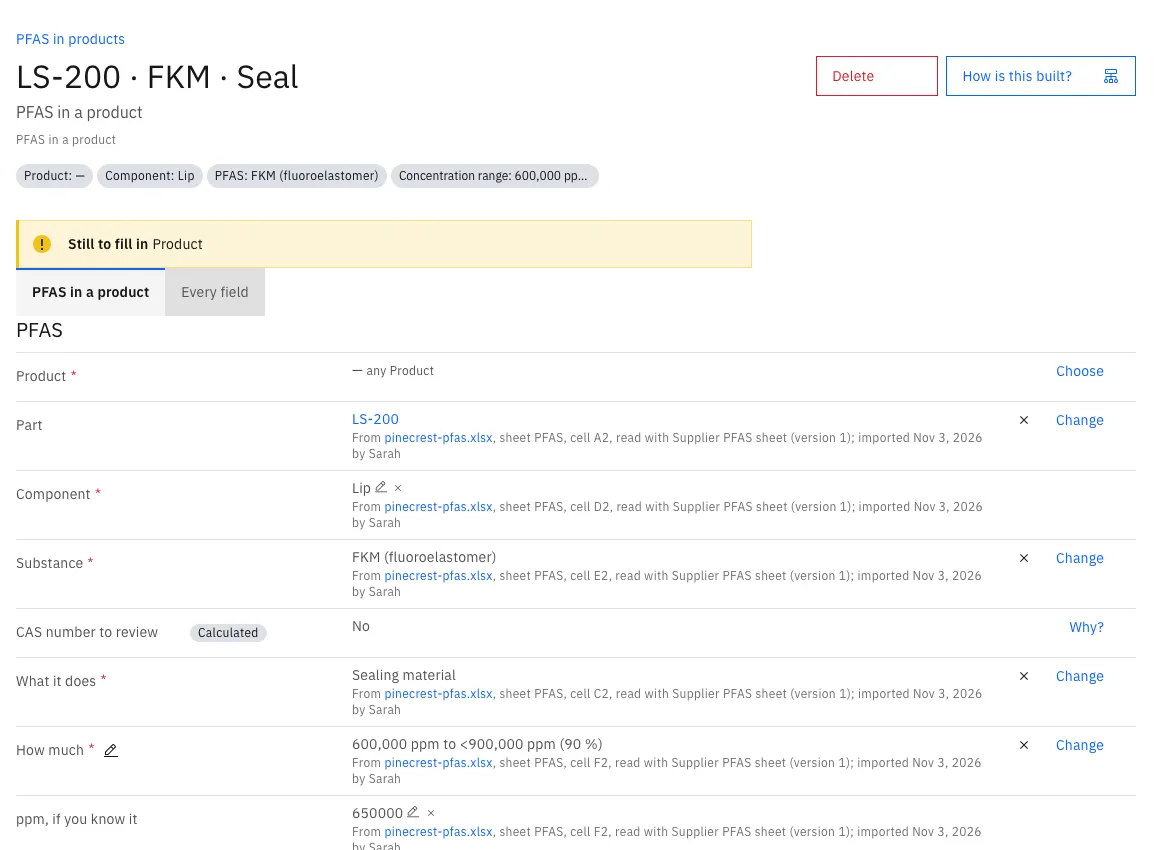
An auditor, a customer or your own manager points at a cell: PTFE, 30 to 60 percent. Who said so, and when? In a spreadsheet, the answer is in someone's inbox, if it's anywhere.
In Verarbo every value keeps its source: the supplier's file, the sheet and cell it came from, and the day it arrived. Or the supplier's own answer, given on their request page. Click the value and you see it.
02 / 07
The supplier's spreadsheet arrives
Suppliers send their own files: different columns, "n/a" where a number should be, a CAS number with a digit missing. Copy and paste carries the mistakes into your master sheet, where they wait for the filing.
Verarbo reads a supplier's sheet through a template you approve once. You see a preview before anything is written, and a row that doesn't fit stops the file, with its reason. A CAS number that isn't a known PFAS (on EPA's lists, or one they miss, such as PVDF) is flagged for you to check. Suppliers who'd rather not send a file answer on a form instead.
03 / 07
Your parts list moved
Your ERP gains parts every week. The spreadsheet knows only the parts someone copied in, so a new part from a new supplier can go unasked until filing time.
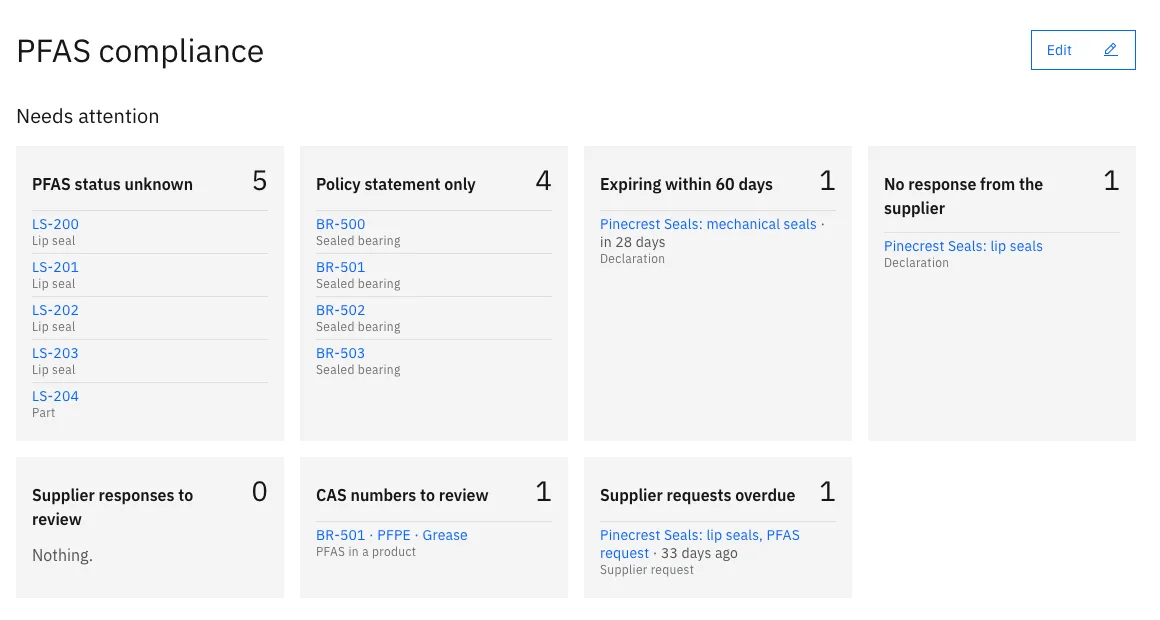
Verarbo imports your parts list from your ERP's regular export. A new part shows up marked Unknown, on the list of what still needs an answer. Nothing is ever written back to your ERP.
04 / 07
"Who hasn't answered?"
With forty suppliers, the hard part isn't the questionnaire. It's knowing who answered, who was reminded and whose email bounced. That lives in a tracking tab and in people's memory.
In Verarbo each supplier gets a request with a link and answers without an account. Reminders go out on their own after one, two and three weeks. Every email sent, delivered or bounced is logged on the request, and overdue requests are listed, ready to escalate.
Some suppliers won't name the substance or the amount, or don't know it. It's hardest with small amounts in formulated materials, such as resins, adhesives, coatings and solder flux, and with fluoropolymers and fluoroelastomers (PTFE, PVDF, FKM, FFKM), which often aren't on a safety data sheet. The request names them. When the answer is still unknown, you record exactly that, with the answers PRISM accepts for it, and the contact log shows you asked.
05 / 07
Someone typed over it
Spreadsheets get shared, sorted and pasted over. A range changes from 60 to 30 percent, and nobody knows who changed it or why.
Verarbo records every change: who made it, when, and what was there before. An admin can undo a mistake in one click, and the undo is recorded too. Nothing is erased.
06 / 07
The filing template says no
PRISM, Minnesota's reporting system, takes an Excel template with its own lists and rules: its exact PFAS names, its nine concentration ranges, a 12-digit UPC. A value it doesn't accept turns a cell red, and the hunt through your sheet begins.
Verarbo writes your rows in PRISM's own words. It checks every value against the template you downloaded, its lists and its rules, before filling anything. A value that doesn't fit is shown with its product and cell. When all of them fit, you get the template back filled, its own checks intact.
Beside it comes an evidence pack: for each row, the declarations, parts and suppliers behind it, and where each value came from. When PRISM's template changes, you run the export again. You don't re-key.
07 / 07
The next filing
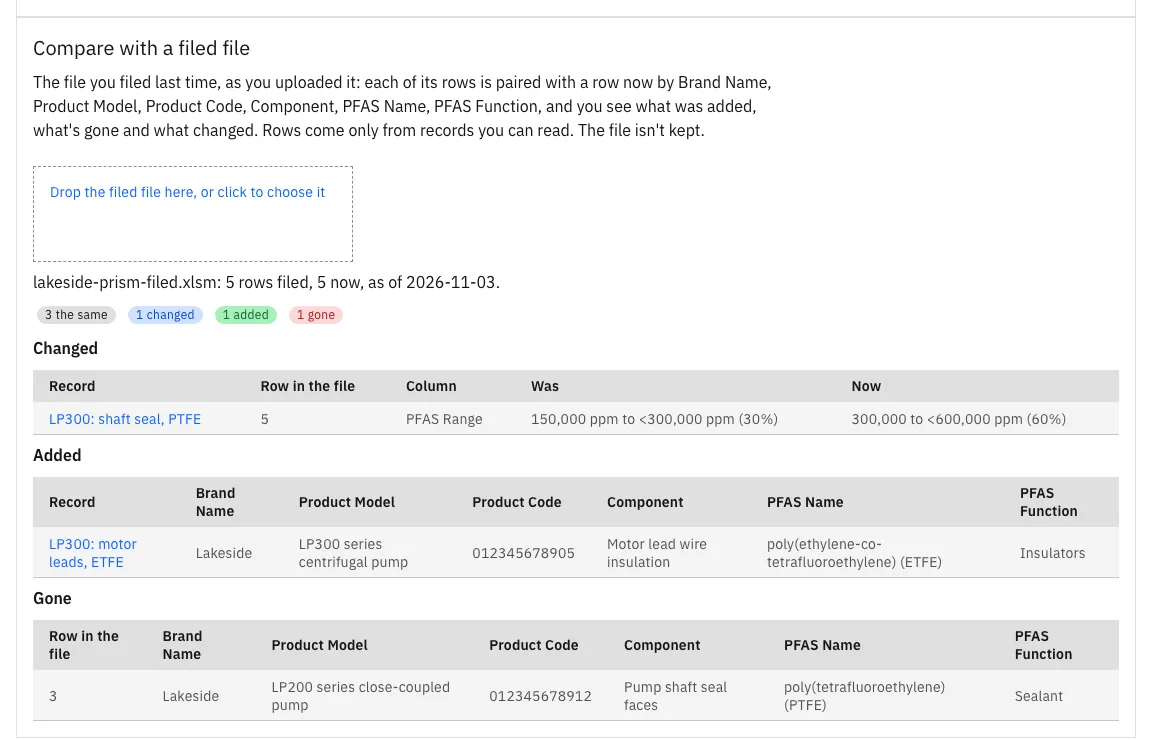
The first report isn't the last. Each year by February 1, Minnesota expects an update if a product changed, new information about a product reached you, or a new product went on sale. With spreadsheets, that means holding last year's file next to this year's and comparing them row by row, by eye.
In Verarbo you drop in the file you filed last time, whether it came from Verarbo or was typed in Excel. Each of its rows is paired with what you'd file today. You see what was added, what's gone and which values changed, each linked to its record and the evidence behind it. The update is a list of differences, not a second filing from scratch.
and
What stays the same, and what Verarbo doesn't do
Excel doesn't go away. Suppliers still send spreadsheets and PRISM still takes one: Verarbo reads the first and fills the second. Your ERP stays as it is.
Verarbo doesn't phone your suppliers or argue with them. The requests and reminders go out on their own; the follow-up calls are yours, or your consultant's. And it doesn't decide what's legally reportable: it checks the data, and you decide.
Who it's for
Verarbo is for manufacturers with hundreds to thousands of parts in an ERP. That's too many for a spreadsheet to stay right, and too few to justify an enterprise compliance suite. If that's you, ask us to show it on your own parts list.
sources
- Minnesota Statutes 116.943: who reports (subd. 1, "manufacturer"; subd. 2)
- Minnesota Rules 7026.0040: the yearly update by February 1
More screens: the product tour.